Making Waste Worth.
The amount of agricultural residue that is produced in India annually is more than 500 million tonnes (NITI Aayog, 2024). A majority of it is burnt, emitting harmful gases and playing a role in the low quality of air in major states. However, would it be possible to turn this waste into wealth — the basis of a sustainable manufacturing revolution?
Here, natural fiber innovation is reforming the material narrative of India. Fibmold, and others, are turning agro-waste into functional, compostable, and aesthetically high-end packaging through science, design and automation — all fitting into current production lines.
It is not an environmental change, but an economic one — a closed, fibre-based economy in which the process of sustainability and scalability can last.
The Case of Change: India’s Material Dilemma.
- Plastic could have been the engine of industrial development but it has brought about a plastic crisis.
- The annual plastic waste production in India amounts to over 3.4 million tonnes (CPCB, 2023), with almost 60 percent of packaging products.
- The rate of recycling is not more than 12 percent, mainly due to multilayered plastics that cannot be recycled.
- Fiber-based packaging, made of sugarcane bagasse, bamboo, or recycled pulp, on the other hand, can be easily composted or reused in paper recycles.
- This is what Fibmold discovered at the beginning:
- To develop a closed-circuit manufacturing system with raw material, product and waste being one sustainable cycle.
Natural Fiber Technology: The Science of Sustainability.
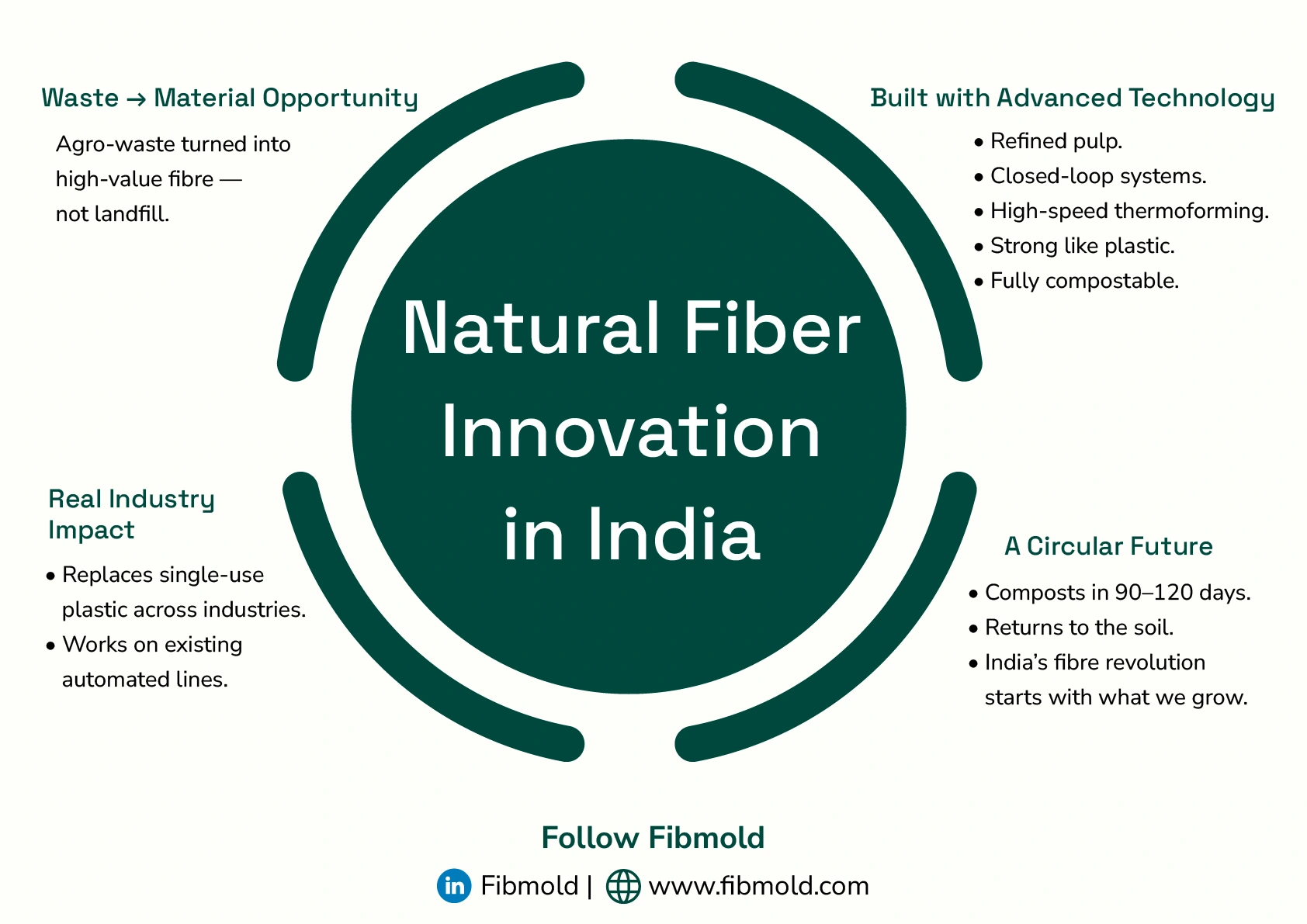
The Molded Fibre innovation of Fibmold starts at the molecular level. The technology used by the company to remove and refine cellulose in bagasse and other agricultural by-products transforms it into pulp that can be utilized in industrial-level forming.
Key Technological Features:
- Closed-loop water systems: The production recycles 95 percent of water.
- None of the chemical finishes: Natural heat finishes leave oils and give resistance to moisture without chemicals.
- High-speed thermoforming: Empowers thousands of eco-friendly FMCG packaging units per day.
- Dimensional precision: Provides compatibility with current automation and sealing systems.
Such properties enable Fibre based Packaging to operate in the same manner as plastic — only being smarter, safer and circular.
Creating a Circular Future: Waste Streams into Value Streams.
The core principle of circular design is to use, recover and regenerate. The Bagasse Packaging of Fibmold is composed of this idea.
Application: The sugarcane residue waste is gathered locally in the form of mills.
Recover: The fibre pulp is refined, pressed and dried using energy-saving processes.
Incinerate: On consumption, the packaging is sent to the ground as compost or to recyclers as pulp.
This cycle eradicates landfill waste and creates agro-waste collection ecosystem jobs in the region — making sustainability a source of livelihood.
The Circular Economy Report released by UNEP in 2024 states that such natural material systems can cut emissions from manufacturing in India by as much as 37% and millions of EPR compliance costs could be saved.
Case Study: Everyday FMCG Fiber Innovation.
One such collaborator that partnered with Fibmold to cut down plastic in its product packaging was a national brand of FMCG that made instant meals and ready-to-eat snacks.
Challenge:
Their current trays and lids were plastic, non-recyclable multi-layer laminates. The adaptation into a sustainable format was associated with loss of mechanical strength and shelf-life stability.
Fibmold's Solution:
- Created Compostable Food Trays with tailored Bagasse Packaging featuring increased heat and moisture resistance.
- Automated filling lines of the brand remained functional and sealed shape maintained.
- Packaging that was made of paper that could be recycled or naturally composted.
Impact:
- Cut down 85 tonnes of plastic use per year.
- Better brand image with clear sustainability labeling.
- Granted EPR exemptions based on classification of recyclable material.
This case demonstrates that material innovation is not only good for the planet but also business-wise viable among Indian manufacturers of fmcg packaging.
The Part Played by India in the World Fiber Revolution.
India holds a special place in the global sustainability transition, with enormous agricultural resources and significant growth in circular infrastructure.
National Momentum:
- The Green Manufacturing Policy is promoting the use of low-carbon materials.
- FSSAI and BIS have issued guidelines for food-safe biodegradable food packaging materials.
- Domestic fibre production is increasing at a rate of 18% per year, fuelled by overseas demand and local innovation centres.
The contribution of Fibmold lies at the intersection of these initiatives — developing India’s potential as a regional centre for sustainable packaging technology.
India is not only saving its own environment by substituting imported plastic polymers with eco friendly packaging boxes and recycled packaging boxes, but also redefining its manufacturing economy.
Beyond Packaging: The Future of Material Development.
- The long-term mission of Fibmold is simple — to make Sustainable Packaging India the synonym of performance and beauty.
- This means creating new fibre composites capable of replacing plastics in all industries, including eco-friendly Electronics packaging, eco-friendly F&B packaging, FMCG containers, pharma trays, and cosmetic inserts.
- Through robotics, data-driven quality control, and Zero Waste Trays, Fibmold will make sustainability a quantifiable measure — not a promotional one.
Conclusion: Fiber Starts the Circular Future of India.
Any revolution is initiated by a material change.
- The transformation of India from a plastic-reliant economy to a fibre-based circular ecosystem is already underway, through innovation, regulation, and consumer awareness.
- The company has just made a move to natural fiber with the Fibmold technology making sustainability not only a dream but an industrial benefit.
- It is not the manufacturing of more — it is the manufacturing of better, and the fibre is the fabric of it.
Be a Part of the Material Innovation Movement in India.
Discover how brands are changing their materials to sustainable ones through Fibmold Molded Fibre, Compostable Packaging, and Bagasse Packaging at www.fibmold.com. Keep up with the latest news in India’s fibre innovation ecosystem by following us on Instagram.