Turning Fields into Factories of the Future.
The amount of farm waste produced annually in India has been above 500 million tonnes; these waste products are sugarcane bagasse and wheat straw, rice husk, bamboo and so forth (NITI Aayog, 2024). It is being burnt in large proportions causing air pollution which engulfs entire regions. What is even better about it is the fact that this waste can be used to make the world better?
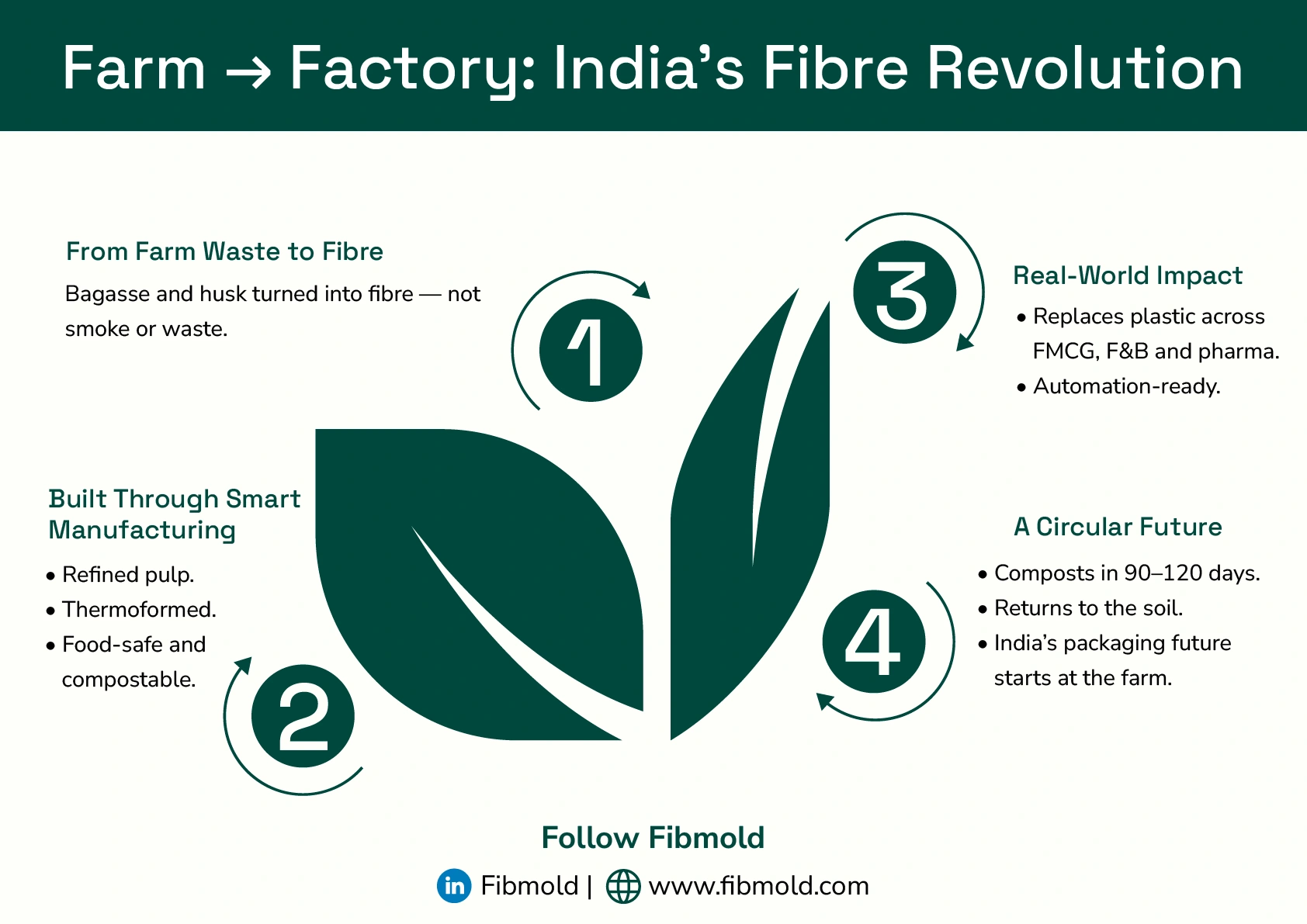
That is exactly what is now going on. India is undergoing a silent revolution — of garbage turning into treasure and fibre forming the core of Sustainable Packaging.
The first one is Fibmold, an innovation-driven company transforming agro-waste into high-performance Fibre based Packaging, which is replacing plastics in food, pharma, and lifestyle industries.
The Farm: The Origin — Where Sustainability Begins.
Sustainability begins even before the packaging line — it begins in the field.
Farmers are left with tonnes of sugarcane, bamboo or straw residue after each harvest. Fibmold extracts these natural fibres directly out of the agricultural fields of the region instead of dumping them or burning them.
Why it matters:
- Circular Sourcing: Sugarcane bagasse is a renewable waste that is abundant.
- Low Carbon Footprint: Use of local material minimizes the logistics and emission.
- New Rural Income Streams: Farmers receive a higher income because they provide agro-fibres.
Fibmold can establish a rural sourcing network ecosystem, which is beneficial to the people and the planet — India is the land of agriculture with the growth of manufacturing.
The Revolution: Science in the Middle of Sustainability.
Upon gathering, the fibres are taken to the state-of-the-art plant of Fibmold — where engineering accuracy and material science converge.
The plant converts waste to produce compostable packaging components which are durable through a mix of Molded Fibre technology, controlled pulp preparation, and automated thermoforming.
Key Process Stages:
- Fibre Refining: Bagasse and other raw residues are refined and purified under closed-loop water systems whereby more than 90 percent of the water can be recycled.
- Thermoforming Innovation: The pulp is thermoformed into trays, scoops and containers that fit the industrial automation lines.
- Quality Control: Quality is provided by testing every batch of products in terms of strength, moisture and heat which meets the demands of FSSAI and international packaging.
It is here that raw residue is made into Bagasse Packaging, able to operate in the heat, under pressure, and transport — being as tough and dependable as plastics.
The Factory to Shelf Journey: The Packaging that Drives Modern India.
After shaping and certification, these packaging products are used in industries which are in the center of Indian business:
- FMCG: Compostable Food Trays and fibre-based scoops of powder and snacks and ready-to-eat meals.
- F&B: oil, heat, and moisture-proof, eco-friendly F&B packaging.
- Pharma and Healthcare: Eco-Friendly Pharma Packaging such as sterile trays and vial inserts.
- Electronics & Lifestyle: eco-friendly Electronics packaging that includes the use of fibre trays that are precision-fitted replacing foam and plastic boxes.
All products are automation engineered — made to run on high-speed filling and sealing lines in plants throughout the country.
Circular Supply Chain in Action: India.
It does not stop after delivery of the packaging but begins as well.
The fibre products are disposed of after use in current paper recycles or compost. They do not need special disposal systems as is the case with multi-layered plastics.
Circular Advantages:
- Compostable Packaging 100% goes back to soil in 90–120 days.
- Recycled Fiber Trays can be put through the recycling process again and made into new packaging.
- Zero Waste Trays imply that there will be no contribution to the landfill — all the grams will return to the cycle.
It is the circular benefit of India, what comes out of the factory goes in the farm, making the process of sustainability complete.
Case in Focus: Fibre Innovation to Empower Local Economies.
In 2024 Fibmold partnered with a cooperative in Maharashtra to receive sugarcane bagasse at mills. Within months:
- More than 4000 tonnes of the residue were recycled to biodegradable food packaging materials.
- Collection and processing units augmented employment in the area by 25%.
- The project saved carbon emission, which would have been equivalent to that of 120,000 trees being planted.
This example demonstrates that sustainable innovation is not only a matter of design, it is an inclusive growth and systemic change.
Proposal: The Revolution that Begins in the Soil.
- Everything in India is a story of regeneration, starting with sugarcane fields of Maharashtra up to the sugarcane packaging lines in Pune.
- Fibmold is transforming the way India makes, uses and recycles packaging through Fibre based Packaging, Compostable Packaging, and Bagasse Packaging.
- It is not simply a revolution of manufacturing but a material awakening which is beginning at the farm and returning to it.
Fibre Future Partner in India.
Fibmold and change the future of packaging agricultural waste.We have Molded Fiber Tray, eco friendly packaging boxes, and Compostable Food Trays at www.fibmold.com.Be updated on India’s developing circular packaging trend on LinkedIn and Instagram.