How Does the FMCG Sector Balance Growth With Green Responsibility?
The Fast-Moving Consumer Goods (FMCG) sector in India is on a rapid rise, estimated to be a $170 billion industry in 2024 and is expected to keep growing fast as rural accessibility continues to expand and digital transactions continue to improve (IBEF, 2024).
However, as this growth comes along, there comes a growing challenge; plastic packaging waste. The Central Pollution Control Board (CPCB, 2023) claims that every year India produces 3.4 million tonnes of plastic waste, and almost 60 percent of this waste is associated with FMCG and F&B packaging.
Why Does High-Volume Sustainability Require a Material Revolution?
Sustainability cannot work without the ability to scale. Although paper and bioplastics are limited, moulded fibre has already demonstrated itself to be the most versatile, automation-friendly material suitable to use in large-scale operations.
The Challenge:
FMCG packaging must be durable and precise and be produced in large quantity.
Plastic fulfills those requirements but cannot be recycled or meet requirements of environmental compliance.Traditional ecological products tend to slow down the lines or increase expenses.
The Solution:
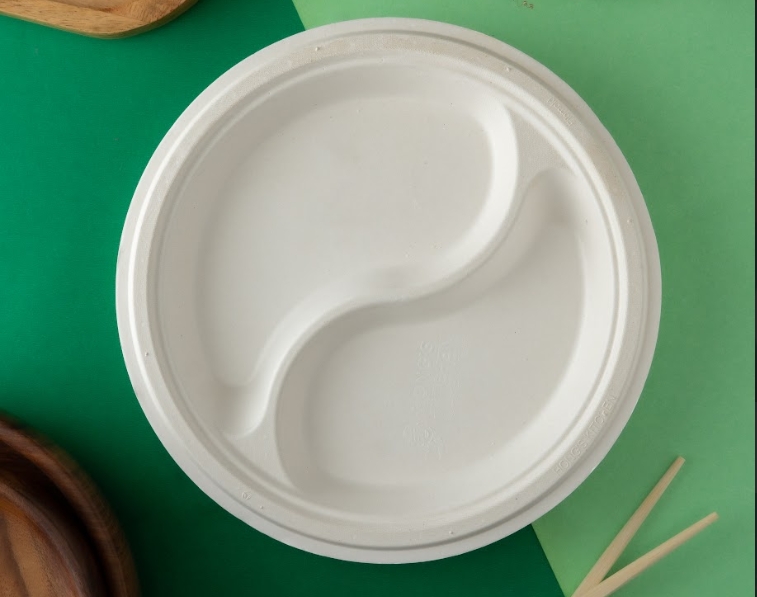
Molded Fibre and Fibre based Packaging by Fibmold provide the functionality of plastic at industrial scale, but are biodegradable, compostable, and do not affect automated filling and sealing systems in any way.
These materials are made out of bagasse, bamboo, and recycled pulp and promote a closed-loop model of production that has low-carbon content. The outcome: Indian FMCG brands are now able to become green without reducing growth.
How Can Fibre Packaging Deliver Scale and Speed in FMCG Manufacturing?
Automation and sustainability meet at the manufacturing plant of Fibmold. Pulp preparation, thermoforming, drying and robotic stacking systems of the company are created to achieve the continuous and high production speed.
The Enablers of Scalability Are:
- High-Speed Moulding Systems: Automated systems that are capable of producing thousands of units of eco-friendly packaging of FMCG a day.
- Dimensional Accuracy: Guarantees that every Molded Fiber Tray or container can be used with available filling and sealing equipment without being retrofitted.
- Water Recycling: 95 percent of the water consumed in production is recycled hence reducing cost and environmental impact.
- Light and Sturdy: Bagasse Packaging is rigid to heat and moisture thus suitable in dry or wet FMCG products.
This infrastructure enables sustainable packaging to act as a performance asset not compromise.
How Does Automation Enable Scalable and Sustainable Fibre Packaging?
The new Plastic Waste Management (PWM) Rules (2022) and EPR framework established by the Indian government is changing the way FMCG companies package their products. Failure to comply will no longer be only a matter of reputation but access to the market.
Using fibre-based solutions, the brands receive regulatory as well as consumer confidence.
Regulatory Edge:
- In line with the FSSAI food-contact safety standards.
- Compliant with 2024 Sustainable Packaging Roadmap of UN Environment.
- Completely biodegradable food wrapping materials to comply with the standards of state-level composting.
Consumer Edge:
Three out of every four Indian consumers indicate their preference to purchase sustainable brands (Kantar, 2024). Environmentally friendly packaging boxes help in increasing the unboxing experience, especially when selling products through e-commerce of FMCGs.To businesses that have to compete on loyalty and long life span, green packaging is not an expense, but rather an investment in image and intent.
How Fibmold Can Help FMCG Transformation.
The product range of Fibmold shows that various FMCG requirements can be achieved in a sustainable way, that is, without compromising efficiency.
a. Fibre-Based Dosing Scoops
The scoops are used in nutrition powders, protein blends and infant formula and are an alternative to plastic without compromising measurement accuracy or structural performance.
b. Cosmetic Inserts
Aesthetically pleasing, plastic-free skincare and beauty kit trays that make the process of unboxing classy and sustainable.
c. Noodle Cups & Dessert Bowls
Compostable Food Trays heat and leakproof ready-to-eat and takeaway products.
d. FMCG Retail Packaging
India requires custom recycled packaging boxes that combine both the branding aesthetics and sustainable packaging characteristics.
All these success stories point out the fact that Fibmold is determined to scale sustainability by using smart design and automation.
How Does Circular Design Make Sustainable Packaging Cost-Effective?
Sustainability does not necessarily mean costly. The circular design model by Fibmold transforms agricultural residues into packaging of value. Using bagasse and other natural fibres that are sourced locally will lower the costs of materials and the carbon footprint of the company.
Economic Benefits Include:
- Reduced waste management cost as a result of compostable packaging.
- Less reliance on foreign raw materials.
- Lightweight transport leads to improved logistic efficiency.
- Negative savings in Zero Waste Trays and saved EPR liabilities.
This will allow the manufacturers of FMCGs to not only fulfill their environmental goals, but also enhance their bottom line, a plus to the planet and output.
Why Is India Poised to Lead the Global Fibre Packaging Future?
- India possesses the material, skill, and size of market to guide the entire world towards the transition into green packaging.
- Indian FMCG companies are not only living up to the eco norms by adopting fibre based materials they are also leading the way in responsible innovation.
- Ranging through the eco-friendly packaging of F&B in quick commerce up to eco-friendly packaging of electronics in smart devices, the possibilities are limitless.
- As the state incentives and the awareness of the population increase, environmentally friendly production is becoming a competitive edge very fast.
- With a 30 percent increase in resource efficiency and increased export potential, as UNEP report 2024 records, countries investing in technologies to produce green packaging experience such an opportunity, and this is what Fibmold is providing to Indian brands.
How Can FMCG Brands Scale Smart While Staying Sustainable?
- It is no longer whether manufacturers of the FMCGs can become sustainable, but how quickly they can be made sustainable.
- We offer the solution: automation-compatible, fibre-based container made in line with the speed, scale and spirit of innovation in India.
- Fibmold is able to demonstrate that performance, profit, and planet are not mutually exclusive by converting agro-waste into high-performance packaging.
How Can Brands Turn Fibre Packaging Into a Long-Term Advantage?
Fibmold takes part in the trend of scalable green packaging.Visit our eco-friendly FMCG packaging, Compostable Food Trays, and Bagasse Packaging at www.fibmold.com.
Keep track of us on LinkedIn and Instagram with new case studies, product innovations and sustainability.