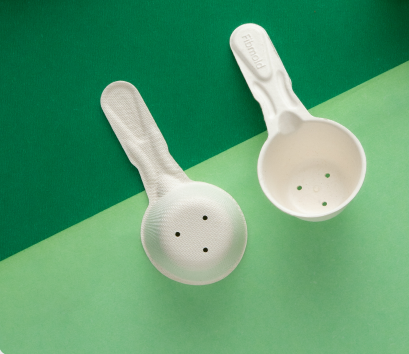
The smallest of the ingredients can exert the most effect on the environment in FMCG packaging. It is the quiet plastic dosing scoop in which plastic powder is available in protein powders, nutraceuticals, health foods and supplements that has become one of the most consistent sources of single-use plastic scoops. These scoops are manufactured in millions, and nearly always they are disposed of in landfills because they are small.
As the FMCG sector in India is expanding at an astonishing rate, brought about by health conscious buyers and online shopping, there is a re-consideration of even the minutest details of packaging by the brands. This is where fibre-based dosing scoops are making a measurable difference.
The Reason Plastic Dosing Scoops Are a Sustainability Question.
Scoops used to dose plastics are not recycled very often. Their size makes them not easily processed by most systems of waste segregation. They are usually littered with food garbage and composed of composite plastics.
UN Environment (2024) emphasizes the fact that small-format plastics form one of the least recycled streams of waste in the whole world. These scoops contribute to an already troubled system of plastic waste management in India as well as providing little long term utility.
Among the most straightforward methods to decrease the usage of plastic, the FMCG brands can switch plastic scoops with some sustainable packaging options without refusing to redesign the whole pack.
Why Fibre-Based Dosing Scoops Are a Better Alternative
Fibre-based dosing scoops are designed to deliver the same functionality as plastic, without the environmental cost.
The molded fibre scoops developed by Fibmold are plastic-free and engineered for:
- Accurate measurement
- Structural stability
- Consistent shape and volume
They are made of scooped material unlike plastic, which fits well into the compostable packaging and recyclable outer packs hence making them a natural fit among the modern FMCG products.
FMCG and Nutraceutical Applications Accuracy.
There is no compromise in the precision in FMCG and nutraceutical packaging.
Fibmold's molded fibre scoops are manufactured to tight tolerances, ensuring:
- Uniform volume
- Consistent weight handling
- Dimensional accuracy
This enables the brands to retain quality standards whilst switching to an eco-friendly FMCG packaging without impacting consumer confidence or experience using it.
Plastic-Free FMCG Packaging Objectives.
Plastic-free packaging does not only limit itself to outer cartons. The consumers are becoming more judgemental about what is inside the pack.
Fibre-based dosing scoops help brands to:
- Do away with another plastic element.
- Enhance plausible sustainability efforts.
- Belong to the goals of zero-waste and low-plastic.
These molded fibre scoops are a low-risk high-impact sustainability opportunity to fmcg packaging corporations in India.
Bagasse Packaging Performance in Fibre Scoop Performance.
Fibmold is made of bagasse packaging, which is made of sugarcane residue which is a renewable and readily accessible agro-waste in India.
Bagasse fibre provides:
- The strength to weight ratio is high.
- Rigid scooping performance
- Faster composting after use
NITI Aayog (2023-2024) also argues that turning agricultural waste into useful industrial materials will contribute to the circular economy objectives of the country, so molded fibre scoops will be both convenient and policy-oriented.
High-Volume FMCG Production Scalability.
Yes--fibre-based dosing scoops are designed for scale.
The infrastructure at Fibmold supports:
- High-volume production runs
- Accurate batch to batch moulding consistency.
- Connection with automated filling lines.
This allows it to be adopted by both niche and high-end segments by large FMCG brands.
The Reason Why FMCG Brands Are Switching to Fibre Scoops.
India is being driven faster along by three primary growth drivers:
Regulatory Awareness
EPR frameworks and Plastic Waste Management Rules are compelling brands to do away with plastic on all levels.
Consumer Expectations
The concept of sustainability is becoming more connected with quality of the product and brand integrity.
Export Readiness
The packaging sustainability is a subject that global markets are now examining closely, including minor bits.
One of the most apparent actions in the direction of sustainable packaging India is the replacement of plastic scoops.
The Way Fibmold Allows a Smooth Transition.
Material replacement ought not to create an inconvenience.
Fibmold works closely with FMCG brands to ensure fibre-based dosing scoops:
- Correlate scoop volumes.
- Adapt well to existing packaging systems.
- Be consistent at scale.
This enables the brands to shift to fibre based packaging without having to create redesigns and stalling of production.
Summary: Little Things Make a Big Difference.
The concept of sustainability does not necessarily demand any gross re-invention. It can start with the smallest plastic part - and do it properly.
Fibre-based dosing scoops demonstrate how thoughtful design, sustainable materials, and scalable manufacturing can deliver meaningful environmental impact.
In the case of FMCG brands in India, such a small alteration has a great impact: sustainability is not accidental, quantifiable, and is incorporated into every aspect.
Stay Connected
Subscribe to Fibmold on Instagram and LinkedIn to get a glimpse of fibre-based packaging, case studies of FMCGs, and various trends in the industry.